
What Full-Service Marketing Actually Looks Like
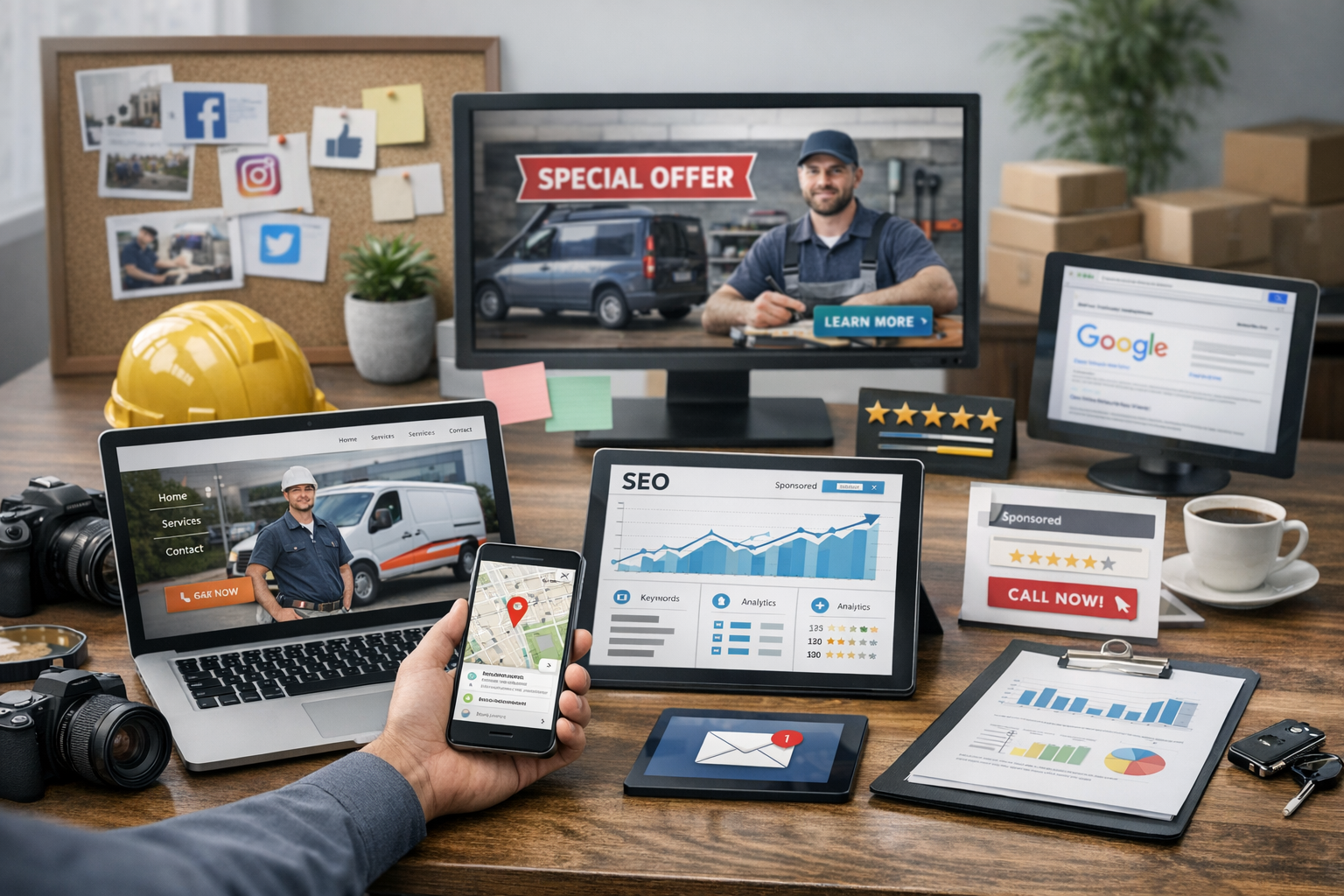
A lot of small business owners hear the phrase full-service marketing and think it means somebody posting on Facebook a few times a week, maybe running an ad, then sending over a report with a bunch of numbers nobody has time to read.
That’s not it.
Real full-service marketing is bigger than one task, but it’s also more practical than most agencies make it sound. It’s the stuff that actually helps a business get found, look trustworthy, and turn attention into phone calls, quote requests, bookings, and sales.
For a lot of local businesses, that means a new website. Or fixing the one they already have. It means getting found on Google in Florence, AL, Muscle Shoals, AL, Sheffield, AL, Tuscumbia, AL, and the rest of The Shoals. It means showing up for someone searching web designer near me, SEO company near me, website help near me, marketing agency near me, or local SEO near me and having a site that doesn’t fall apart when they land on it.
And honestly, that’s where a lot of companies are losing money without realizing it.
It starts with the basics, not the buzzwords
If someone calls themselves full-service, they should be able to look at the whole picture. Not just one piece.
That starts with the website. Not a pretty homepage alone. The whole thing. Does it load fast on a phone? Does it make sense in three seconds or less? Can a visitor tell what you do, where you work, and how to contact you without hunting around?
You’d be surprised how many contractors, HVAC companies, plumbers, electricians, and local restaurants are still running sites that are slow, broken on mobile, or stuck in 2017. I’ve seen businesses in Jackson, TN, and across The Shoals spend good money sending traffic to a website that doesn’t answer the basic questions. Then they wonder why calls aren’t coming in.
That’s not a traffic problem. That’s a website problem.
Full-service marketing also means looking at branding. Not some fancy logo exercise for the sake of it. I mean the actual look and feel of the business online and off. If your truck graphics say one thing, your website says another, and your Facebook page hasn’t been updated in six months, customers notice. Maybe not consciously. But they notice.
Trust gets built in those details.
SEO matters more than people want to admit
Search engine work gets thrown around a lot, usually by people trying to sell something cheap and quick. And that’s part of the problem. Too many small businesses have already been burned by bad SEO work from cheap agencies that promised rankings and delivered a pile of weak content, random backlinks, and no calls.
Good SEO isn’t magic. It’s making sure your business shows up when someone nearby is actually looking for what you do.
If you run a roofing company, landscaping business, auto repair shop, medical clinic, or industrial service company, you want to appear when people search locally. Not just anywhere. Right there in your area. That means your pages need to be built around the services you actually offer, the towns you actually serve, and the questions people actually ask.
That also means your Google Business Profile matters. A lot. More than a lot of owners think. If it’s half-filled out, has old hours, bad categories, weak photos, or no review strategy, you’re leaving money on the table. Simple as that.
I’ve seen businesses in Florence and Sheffield lose good leads to smaller competitors who just had their local listings cleaned up and their reviews handled better. Not because the other company was better at the job. Because they were easier to find and easier to trust.
Content isn’t filler. It’s how people decide you’re real
Most business owners don’t wake up excited to write blog posts. Fair enough. They’re busy. They’ve got crews to manage, customers to call back, parts to order, and invoices sitting on the desk. The marketing stuff gets pushed to the side.
That’s normal. But the internet doesn’t care how busy you are.
Content marketing, done right, gives people a reason to stick around. It answers questions before they call. It builds confidence. It gives Google more context. And it keeps your site from looking like a dead brochure with no pulse.
For a plumbing company, that might mean pages or articles about water heater issues, drain problems, or signs a homeowner needs help now. For a boutique, it could be seasonal features, product highlights, and local event tie-ins. For a farm-related business, it may be service areas, equipment support, supply availability, or practical guides people search for without thinking twice.
It doesn’t need to be fancy. It needs to sound like somebody who knows the work and knows the customer.
Social media is part of the job, but it’s not the whole job
A lot of small businesses around Florence, AL and Jackson, TN still rely almost entirely on Facebook, and that becomes a problem the second engagement drops. One algorithm change and suddenly the phone slows down.
Social media is useful. No question. It helps keep your name in front of people. It gives your business a face. It can support promotions, reviews, hiring, and seasonal pushes. But if that’s the only place your marketing lives, you’re building on rented ground.
Full-service marketing ties social into the rest of the system. Posts should support the website. Website traffic should support lead generation. Lead generation should support email. Email should support repeat business. Reviews should support search visibility. It all connects.
Too many businesses are posting just to post. A picture of a truck. A holiday graphic. A random quote. Fine, but if none of it drives action, it’s just noise.
Paid ads can help, but only if the rest is in place
I’ve seen owners waste money on ads because they were told it was the fastest path to leads. Sometimes ads do work well. Sometimes they don’t. Usually the problem isn’t the ad itself. It’s what happens after somebody clicks.
If the landing page is weak, the offer is unclear, the form is clunky, or the phone number is buried, the money leaks out fast.
That’s why full-service marketing looks at the whole route. Ad clicks are one piece. Website performance is another. Follow-up matters too. If someone fills out a form and hears nothing for a day, that lead may be gone. If your team doesn’t answer calls after hours, you need a plan for that. Otherwise you’re paying to send people to voicemail.
That’s not strategy. That’s expensive guessing.
Email still works, even if people act like it doesn’t
Email marketing gets ignored by a lot of local businesses, which is strange because it’s one of the few things you actually own.
If you’ve got past customers, repeat clients, estimate follow-ups, seasonal reminders, special offers, or maintenance schedules, email can do real work. HVAC companies use it. Medical clinics use it. Auto shops use it. Restaurants and boutiques can use it for specials and events. Construction and industrial service companies can use it to stay top of mind for larger projects that take time to move.
No, it doesn’t have to be fancy. It just has to be useful and consistent.
A real local example
We’ve worked with businesses that were doing decent work in the field but not showing it online. One example that sticks with me is a local service company that had a strong word-of-mouth reputation around Florence and Muscle Shoals, but the website was outdated, slow on mobile, and missing basic service pages.
People were finding them, sure. The traffic was there. But the site didn’t answer enough questions, and calls were thin.
We cleaned up the website, updated the messaging, improved the Google Business Profile, tightened the local SEO, and gave the business a more consistent look across the board. Nothing flashy. Just the right pieces in place.
The difference wasn’t overnight magic. It was steady. Better rankings. Better calls. Better lead quality. Fewer people landing on the site and leaving confused.
That’s what full-service marketing is supposed to do. Make the whole thing work together instead of hoping one channel carries the load.
What it looks like in the real world
For a local business, full-service marketing usually includes some mix of these things:
A website that loads fast, works on mobile, and explains the business clearly
SEO that helps the company show up in Google for the right searches
Local SEO that gets the business found in Florence, AL, Muscle Shoals, AL, Sheffield, AL, Tuscumbia, AL, The Shoals, and beyond
Google Business Profile work that supports calls, directions, reviews, and trust
Content that answers real customer questions
Branding that feels consistent across the website, social media, trucks, print pieces, and emails
Paid ads that are built to convert, not just spend money
Reputation management that helps good businesses look like good businesses online
Email follow-up and nurturing for past and future customers
Lead tracking so you know what’s actually working
That’s a lot, sure. But that’s the point. Most small businesses don’t need more noise. They need somebody who can connect the dots.
Actionable takeaways you can use now
If your business is trying to grow, start here.
First, check your website on a phone. Don’t just glance at the homepage. Try to find your services, your contact info, and your service area. If it takes too much tapping, fix that.
Second, look at your Google Business Profile. Are the hours right? Are the photos current? Are reviews being answered? Is your category correct?
Third, ask yourself if your website actually says what you do in plain language. A lot of sites don’t. They talk around the job instead of stating it.
Fourth, stop relying on one channel. Facebook is fine. Ads are fine. But neither one should be the whole plan.
Fifth, pay attention to calls and forms, not just traffic. Traffic that doesn’t turn into leads is just a number.
Sixth, if you’ve already been burned by bad SEO or a cheap agency, don’t assume all marketing is the same. It isn’t. The difference is in the work and in the follow-through.
Bottom line
Full-service marketing isn’t about doing everything for the sake of saying you do everything. It’s about getting the right pieces working together so your business can actually grow without relying on luck.
For a local company, that might mean showing up better in Google, cleaning up an outdated website, fixing a broken mobile experience, tightening branding, posting with a plan, handling reviews, and making sure paid ads aren’t wasting your budget. Sometimes it also means telling the truth about what’s not working and starting there.
If you’re a business owner in Florence, AL, Muscle Shoals, AL, Sheffield, AL, Tuscumbia, AL, The Shoals, or Jackson, TN, and you’ve been feeling like your marketing is busy but not productive, that’s usually a sign the pieces aren’t connected yet.
That’s fixable.
Brian JR Williamson
Managing Member
Lime Group, LLC
Web Design • SEO • Content Strategy • Online Marketing
(256) 443-2714 | (731) 215-5449
Serving Florence, AL • The Shoals • Jackson, TN
jr@limegroupllc.com
www.limegroupllc.com
