
Google Ads Management: What Small Businesses Should Expect
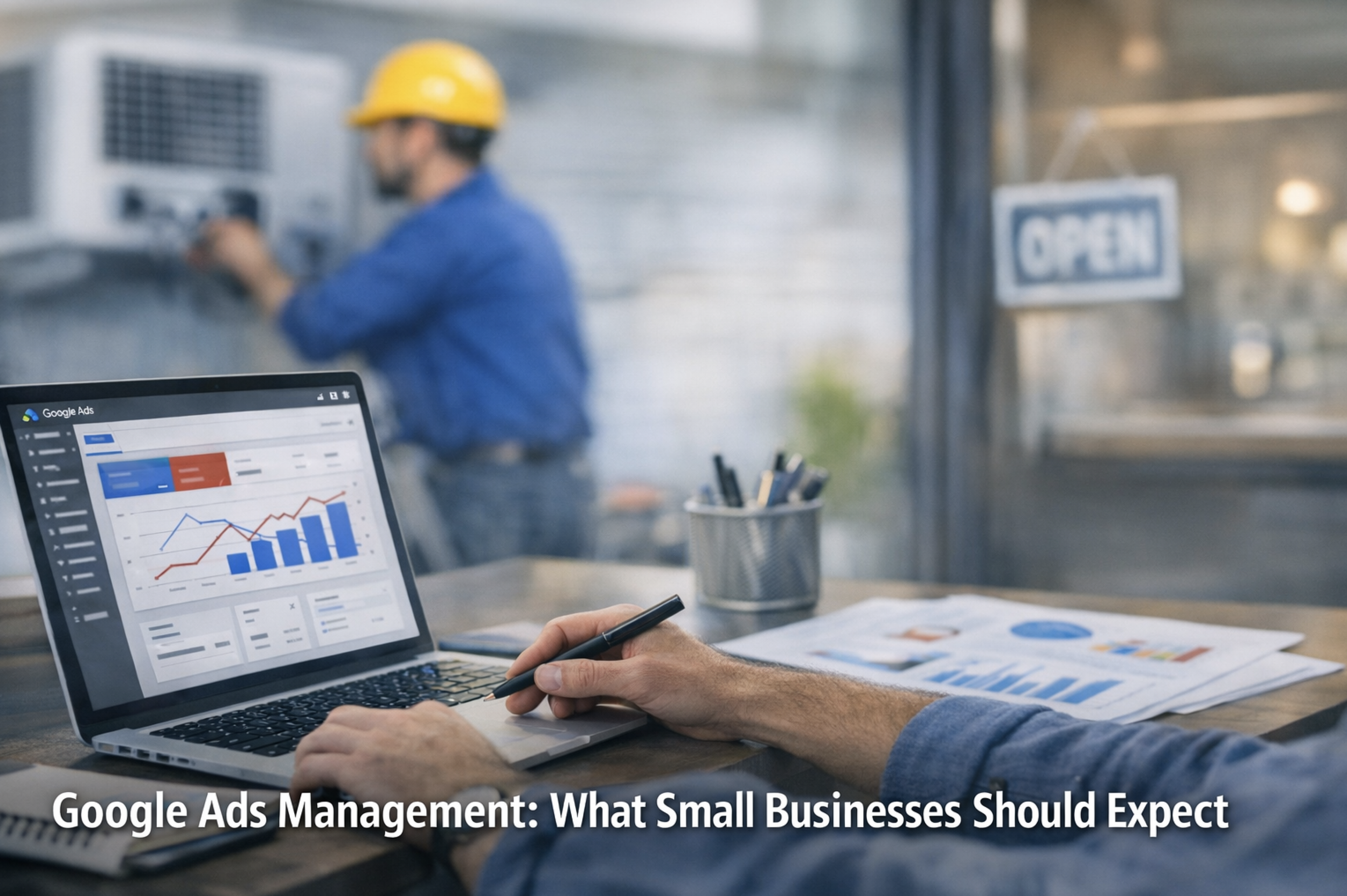
If you run a small business, Google Ads can feel like one of those things everybody tells you to do, but nobody really explains well. You hear it can bring leads fast. You also hear stories about people burning through money with nothing to show for it. Both are true.
The difference usually comes down to expectations. Not the flashy kind. The real ones.
For a local business in Florence, AL, Muscle Shoals, AL, Sheffield, AL, Tuscumbia, AL, or anywhere in The Shoals, Google Ads can be a solid way to get in front of people who are already looking for what you sell. Same thing in Jackson, TN. If somebody is searching for an HVAC repair company, a plumber, an electrician, a medical clinic, a landscaping crew, or even a local restaurant with a lunch special, they’re not browsing for fun. They’re looking because they need something now.
That’s where Google Ads can work. But it’s not magic. And it’s not a set-it-and-forget-it thing either.
What Google Ads actually does for a small business
Google Ads puts your business in front of people based on what they search. That part sounds simple enough. But the real value is timing. You’re catching someone at the moment they’re asking a question or trying to solve a problem.
That matters a lot for home service businesses and local service companies. A homeowner doesn’t always remember the name of a plumber until a pipe bursts. A business owner doesn’t think about industrial cleaning or equipment repair until they’re staring at a problem that needs fixing now. Ads let you show up in that moment.
Still, showing up is only half the job. What happens next matters just as much. If the ad sends people to a slow website, a broken mobile page, or a page that doesn’t clearly explain what you do, the lead is gone. Doesn’t matter how good the ad looked.
What small business owners should expect from a real campaign
First, you should expect setup work. Good Google Ads management isn’t just tossing money at keywords and hoping something sticks. It starts with understanding the business, the service area, the seasonality, the competition, and what kind of lead is actually worth paying for.
A plumbing company in Tuscumbia won’t need the same ad strategy as a boutique in Florence or an auto shop in Jackson, TN. A local restaurant might care more about lunch traffic, catering, or weekend bookings. An HVAC company may need stronger calls during extreme weather. A construction company may want bigger project leads, not random tire-kickers asking for estimates they can’t afford.
That sounds obvious, but a lot of agencies skip right past it.
Then there’s the landing page. If your website was built years ago and nobody’s touched it since, you already know the problem. Too many small businesses are still sitting on sites that look fine on a desktop but are slow or broken on mobile. Most people never call if the page loads like it’s stuck in 2014.
If someone is searching on their phone for website help near me or a marketing agency near me, they’re probably ready to act. But they won’t wait around for a page that takes forever to load or doesn’t have a clear phone number at the top.
You should also expect testing. Headlines. Calls to action. Service areas. Ad copy. Sometimes even the offer itself.
That part takes patience. A decent campaign usually needs a little time to figure out what’s pulling its weight and what’s not. One ad might get clicks but no calls. Another might not get many clicks at all, but the calls it does bring in are better quality. That’s the kind of thing you only see once the campaign is running.
What you should not expect
Don’t expect instant perfection. And don’t expect every click to turn into a customer.
There’s a weird idea out there that Google Ads should just produce leads on demand. That’s not how it works. If your website is weak, your reputation is shaky, or your offer is vague, paid ads won’t fix that. They’ll just make the flaws show up faster.
We’ve seen businesses spend money on ads while their Google Business Profile was half-finished, their reviews were outdated, and their phone number didn’t even match what was on the site. That’s not a traffic problem. That’s a trust problem.
Same thing with businesses that rely only on Facebook. A lot of small businesses around Florence and Jackson still lean almost entirely on Facebook, and that becomes a problem the second engagement drops. Social media is fine, but it’s borrowed attention. Google Ads and local SEO near me searches usually catch people with stronger intent.
Also, don’t expect every ad manager to care about your actual business goals. Some will talk in circles about impressions and clicks and make it sound busy. Busy doesn’t pay the bills. Calls, forms, bookings, and sales do.
What good management looks like
Good Google Ads management should feel grounded. Not glamorous. Grounded.
You should know what you’re paying for. You should know which services are getting attention. You should know where the calls are coming from. You should know whether the campaign is bringing in residential jobs, commercial work, emergency calls, or the wrong kind of traffic entirely.
Good management also pays attention to the rest of the picture. SEO, local SEO, content marketing, branding, online reputation, and your website all play a part. Ads work better when your site has solid service pages, clear location signals, and real content that answers what customers are asking.
If your site has thin content and no local context, Google has less to work with. If your Google Business Profile is incomplete, your map visibility can suffer. If your reviews are weak or inconsistent, people get hesitant fast. That’s just the way it is.
For local businesses in The Shoals, that can be the difference between showing up or disappearing under bigger regional companies with bigger budgets. A local company doesn’t always need to outspend the competition. It needs to outlocal them. Better service pages. Better pages for each area served. Better reviews. Better tracking. Better calls to action. Better follow-up.
A real local example
We’ve seen this play out with home service businesses more than once. A contractor in the Florence area was getting plenty of website traffic, but almost no calls. The owner thought the ads were the problem. Turned out the ads were doing their job. The website wasn’t.
The site was slow on mobile, the main phone number wasn’t easy to find, and the service pages were thin. The brand looked a little all over the place too. Some pages used one name format, other pages used another. Reviews were scattered. The Google Business Profile hadn’t been touched in months.
Once that was cleaned up, leads got better. Not perfect overnight. But better. The difference came from treating the whole setup like a system instead of expecting one ad campaign to carry everything.
That happens more than people think. A lot of business owners don’t realize how many leads they’re losing from an outdated website until somebody finally shows them the numbers. Then it clicks.
Where small businesses waste money
One of the biggest money leaks is paying for traffic that never had a chance to convert.
That usually happens when ads are too broad, landing pages are weak, or the campaign is built around the wrong goal. It also happens when nobody is watching search terms closely. If you run ads for a local restaurant, you don’t want to keep paying for irrelevant searches that never lead to a reservation or order. Same for a medical clinic or an automotive shop. Bad traffic can sneak in fast.
Another waste point is poor follow-up. If someone calls and nobody answers, or forms sit in an inbox too long, the lead is gone. Simple as that. Ads can do the heavy lifting, but they can’t close the deal for you.
And then there’s bad SEO work from cheap agencies. We see this all the time. Pages stuffed with awkward wording. Location pages written like they were copied and pasted from a template. Content that doesn’t sound like a real local company. It might look active from the outside, but it doesn’t help rankings or trust much.
That’s why ads, SEO, and website design need to work together. If one piece is off, the whole thing feels weaker.
What to ask before you start
If you’re talking with a web designer near me, an SEO company near me, or a marketing agency near me, ask plain questions.
What happens to the traffic after the click?
How do you track calls and form submissions?
What locations are you targeting?
How often will the campaign be reviewed?
What changes are made if the ads aren’t performing?
How do Google Ads connect with the rest of the marketing plan?
Those questions tell you a lot. A real partner won’t mind them. They’ll probably be glad you asked.
If someone only talks about clicks and not leads, be careful. If they ignore your website performance, be careful. If they never mention your Google Business Profile, reviews, or local content, that’s another warning sign.
Actionable takeaways for small business owners
Start with a website that works on mobile. Not someday. Now.
Make sure your phone number is easy to find. Same with your service area and main offers.
Keep your Google Business Profile current. Hours, photos, categories, services, all of it.
Don’t rely only on social media. Use it, sure. But don’t let it be the only place people can find you.
Track calls, forms, and bookings. If you can’t measure the lead, you can’t improve the campaign.
Use real content on your site. Not filler. Real answers to real questions.
Ask for reviews regularly. A steady stream beats a random burst every time.
Be patient, but not passive. A campaign needs time, but it also needs attention.
Bottom Line
Google Ads can be a smart move for small businesses, but only if you know what to expect. It’s not a magic switch. It’s a tool. A useful one, when it’s set up right and supported by a solid website, local SEO, good branding, and real follow-through.
For businesses in Florence, AL, Muscle Shoals, AL, Sheffield, AL, Tuscumbia, AL, The Shoals, and Jackson, TN, that usually means focusing on the basics first. Show up where people are searching. Make it easy to call you. Don’t send traffic to a site that can’t carry the load. And don’t spend money just to feel active online.
The businesses that get the best results usually aren’t the loudest. They’re the ones that stay consistent, fix the weak spots, and pay attention to what customers are actually doing.
That’s the real work.
If you’re trying to figure out whether Google Ads make sense for your business, or you’re already spending money and not seeing much back, it may be time to look at the whole picture. Sometimes the ads are fine. Sometimes the website needs work. Sometimes the local SEO is what’s holding everything back. And sometimes, yeah, the campaign just needs somebody who knows how to manage it properly.
Brian JR Williamson
Managing Member
Lime Group, LLC
Web Design • SEO • Content Strategy • Online Marketing
(256) 443-2714 | (731) 215-5449
Serving Florence, AL • The Shoals • Jackson, TN
jr@limegroupllc.com
www.limegroupllc.com
