
What Makes a High-Converting Website
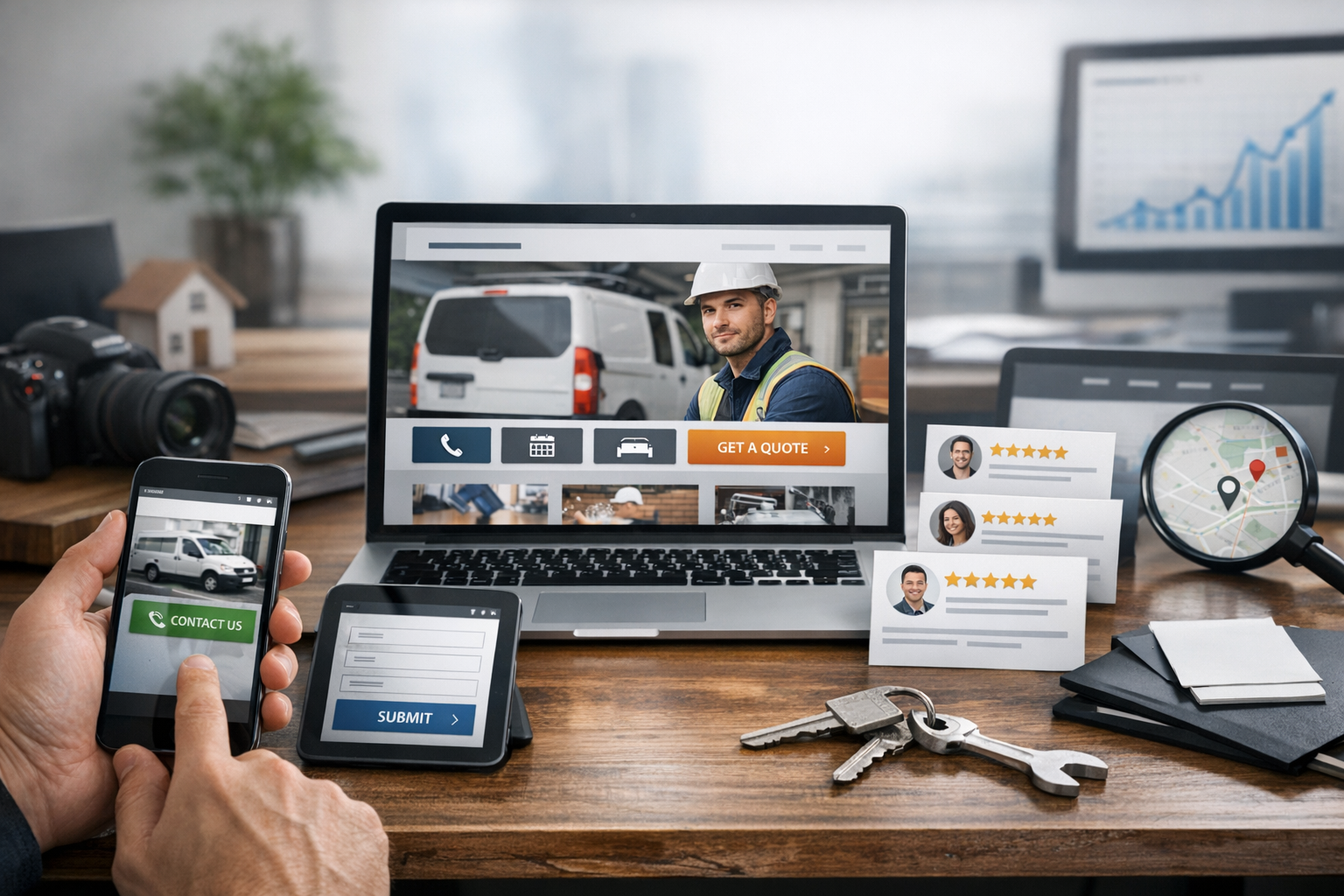
A lot of business owners think a website just needs to look decent and list a phone number. That used to be enough. Not anymore.
These days, your website has to do some real work. It has to answer questions fast, build trust, show up in Google, and get people to take the next step. Call. Fill out the form. Book the service. Stop by the shop. Whatever the goal is, the site should push people there without making them think too hard.
And that’s where a lot of small businesses get stuck. They’ve got traffic coming in, maybe even a few ads running, but the phone isn’t ringing. Or the website gets seen, but nobody reaches out. I’ve seen that a hundred times with HVAC companies, plumbers, electricians, restaurants, clinics, construction crews, auto shops, and local retail shops around Florence, AL, Muscle Shoals, AL, Sheffield, AL, Tuscumbia, AL, and the rest of The Shoals. Same story in Jackson, TN too.
A high-converting website isn’t about fancy design for the sake of it. It’s about making it easy for the right customer to say yes.
First, the site has to load fast and work on a phone
This sounds basic, but you’d be shocked how many local business websites still load like it’s 2014. Big images. Broken buttons. Tiny text on mobile. Menus that are a pain to tap. If someone has to pinch and zoom just to read your hours, they’re already halfway gone.
Most people are checking your site from their phone. They’re standing in a parking lot, sitting at a job site, or comparing you to two other companies while waiting on lunch. If your site is slow or clunky, they’re not going to wait around. They’ll hit back and call someone else.
This matters even more for home service businesses. If a homeowner in Florence needs a plumber or AC repair right now, they want fast answers. Not a pretty homepage with a giant stock photo and no clear next step.
People need to know what you do right away
One of the biggest mistakes I see is a website that tries to be clever instead of clear. Business owners like the look of it, but customers are confused. If someone lands on your site and can’t tell within a few seconds what you actually do, you’ve got a problem.
Your homepage should answer a few simple things fast:
What do you do?
Where do you do it?
Why should someone trust you?
What should they do next?
That’s it. No guessing games. No scrolling through six sections to find a phone number. No vague taglines that sound nice but say nothing. A lot of businesses waste money on design that looks polished but doesn’t convert because nobody bothered to make the message clear.
That’s especially common with companies relying only on Facebook. Facebook can help, sure. But it’s rented space. If the page gets less reach, or the algorithm changes, your visibility drops fast. Your website is the one place you control.
Trust is doing a lot of the heavy lifting
People don’t convert on hope. They convert when they feel comfortable.
That means your website has to look like a real business runs behind it. Actual photos help a lot. So do customer reviews, service area details, license or certification info where it makes sense, and a clean layout that doesn’t feel hacked together.
Too many local businesses are using old websites with stock photos that don’t match the real company at all. A roofing company using smiling office people in business suits. A farm-related business with generic handshakes and blue gradients. Folks notice. Maybe not consciously, but they notice.
Same thing with branding. If your logo, colors, photos, social media posts, and website all feel like they came from different companies, trust gets shaky. People may not know why, but they feel it.
Good websites make it easy to take action
This is where conversion really happens. A high-converting website doesn’t make people hunt for a phone number or wonder what to do next. It points them in the right direction.
For a local service business, that might mean a sticky call button on mobile. For a restaurant, maybe an easy menu, online ordering, or a directions link. For a medical clinic, it could be appointment requests and insurance details. For a boutique, maybe product highlights, hours, and a simple contact path.
The best websites reduce friction. They don’t add to it.
If someone has to dig through three pages just to request a quote, that’s a bad setup. If the form is too long, they won’t fill it out. If the phone number is buried in the footer, you’re losing easy calls. Simple stuff. But simple stuff is where a lot of leads disappear.
SEO matters, but not the fake kind
I’ve seen plenty of cheap SEO work that did more harm than good. Pages stuffed with awkward keywords. Duplicate content. City names jammed into every paragraph. It may have looked busy, but it didn’t help rankings much, and it sure didn’t help leads.
Real local SEO is about being useful and being findable. Your site should be built around the services people actually search for, the cities you actually serve, and the questions they actually ask.
That means having strong service pages. It means clear location signals for Florence, AL, Muscle Shoals, AL, Sheffield, AL, Tuscumbia, AL, and nearby areas. It means connecting your website to your Google Business Profile so Google understands who you are and where you work. It also means making sure your business info matches everywhere online.
Most business owners don’t realize how many leads they’re losing from bad local SEO until they finally show up for the right search terms. Or worse, until they realize a competitor with a weaker business is outranking them just because their website is cleaner and more focused.
Your content has to answer real questions
Content marketing sounds fancy, but really it just means answering the questions your customers are already asking.
An HVAC company can write about signs your system is failing before summer. A landscaping business can explain the best time to overseed in North Alabama. A construction company can talk about how to plan a remodel without blowing the budget. A clinic can break down what to bring to a first visit. A restaurant can highlight seasonal specials or catering options.
This kind of content helps in two ways. First, it gives people a reason to trust you. Second, it helps with Google rankings because your website starts matching real search intent instead of just sitting there like a digital brochure.
And no, you don’t need to publish every day. A few useful pieces done well will beat a pile of random posts that nobody reads.
Reputation still matters a whole lot
People check reviews before they call. Period.
Even if your website looks great, bad reviews or no reviews can slow things down. A high-converting website works better when it’s backed by a strong online reputation. That doesn’t mean you need hundreds of reviews. It means you need enough real feedback to make people comfortable.
It also helps to show those reviews on the site in a natural way. Not in a loud, awkward way. Just enough to reinforce that real customers have worked with you and had a decent experience.
For local businesses in smaller markets, this matters even more. In The Shoals or Jackson, TN, people talk. They check Facebook comments. They ask around. They compare notes. If your reputation is weak online, it shows up in your lead flow faster than you’d think.
Paid ads won’t fix a weak website
This is one of the most frustrating things I see.
A business owner spends money on ads, gets decent traffic, and still nothing happens. No calls. No form fills. No bookings. Then they assume ads don’t work.
Usually, the ads aren’t the problem. The landing page is.
If someone clicks an ad and lands on a site that’s confusing, slow, or not built for the offer, they leave. Just like that. You can’t spend your way around a bad website. The page has to carry its weight.
That’s true for Google Ads, Facebook ads, and even boosted posts. A good website gives your marketing somewhere solid to land.
A real local example
I worked with a local home service company that had steady word-of-mouth business but wasn’t getting much from the website. They had decent traffic. The problem was the site didn’t really tell people what to do, the phone number wasn’t easy to find on mobile, and the service pages were thin. It looked fine at a glance, but it wasn’t built to convert.
We tightened up the messaging, cleaned up the mobile layout, added clearer service pages, connected the website better to their Google Business Profile, and fixed a few technical issues that were slowing things down. Nothing wild. No magic tricks. Just practical work.
The difference was obvious pretty fast. More calls. Better leads. Less waste.
That’s usually how it goes. The businesses that start getting traction online aren’t always the loudest. They’re usually the ones with a site that works like it should.
What to look at if your website is underperforming
If your site gets traffic but no calls, start here.
Look at your homepage on a phone. Can someone figure out who you are and what you do in ten seconds?
Check your call button. Is it easy to tap?
Look at your service pages. Do they actually explain anything useful?
Review your contact form. Is it short enough to finish without annoyance?
Compare your site with a few competitors in Florence, AL or Jackson, TN. Not to copy them. Just to see what they’re doing better.
Then check your Google Business Profile. Are the photos current? Are the hours right? Is the description decent? Do you have recent reviews coming in?
A lot of owners are too busy running jobs, managing staff, and keeping the lights on to update the website. That’s normal. But if the site is stale, the business starts looking stale too.
Actionable takeaways
If you want a website that brings in more business, start with the basics and do them well.
Make sure your site loads quickly on mobile.
Keep the message clear and simple.
Show real photos and real proof.
Make contact easy.
Build pages around the services people actually search for.
Keep your Google Business Profile active and accurate.
Publish useful content once in a while, not just random updates.
Pay attention to reviews.
And don’t assume more traffic will fix a weak site. Usually it won’t.
Bottom line
A high-converting website isn’t about being fancy. It’s about being useful, clear, and trustworthy.
For small businesses and local service companies, that can make a huge difference. Whether you’re a plumber in Florence, an electrician in Muscle Shoals, a boutique in Tuscumbia, a clinic in Sheffield, a contractor working across The Shoals, or a business trying to grow in Jackson, TN, the same rule applies. If your website makes it easy for people to trust you and contact you, it starts doing real work for you.
And if it doesn’t, people move on. Pretty fast, too.
If your website feels dated, your calls have slowed down, or you’re just not getting much from your online presence, it may be time for a better setup. Not louder. Better.
Brian JR Williamson
Managing Member
Lime Group, LLC
Web Design • SEO • Content Strategy • Online Marketing
(256) 443-2714 | (731) 215-5449
Serving Florence, AL • The Shoals • Jackson, TN
jr@limegroupllc.com
www.limegroupllc.com
